
About
[306] Eia no kāhi koe o ka moamoa.
Here is the only space left, the moamoa.
Said when offering a small space or seat to a friend when every other place is occupied. As Pa’ao was leaving from Kahiki with a canoe filled to capacity, a priest, Makuakaumana, called out, asking to come along. He was offered the only available space—the sharp point at the stern of the canoe, the moamoa.
About Ka Moamoa #
The name Ka Moamoa comes from the culture and traditions of the lab Director, Josiah Hester, a Native Hawaiian.
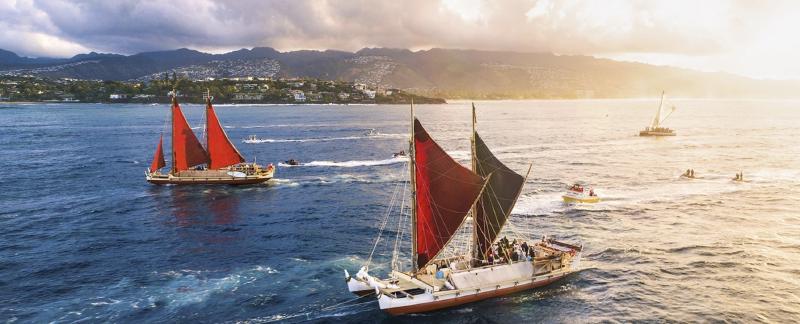
Hawaiian voyaging traditions date back millenia, when Na Maoli first traveled across the ocean from New Zealand to the islands of Hawai’i to establish their homes. They did this without navigational instruments, using open air canoes, with limited food and water. Today, these traditions are kept alive with the Hokule’a: designed like the original canoes that traveled across the ocean, with cultural practitioners as guides using traditional navigation methods, this canoe travels the ocean as a testament to the skill, knowledge, and courage of ancient Hawaiians. This spirit of exploration and adventure inspires us today in our own search for knowledge.
The moamoa (also phrased momoa), is a small flat spot, notch, or indentation on the extreme back end (i ka manu hope) of the traditional voyaging canoes of Hawai’i.
It comes from the story of Pa’ao, who offered the moamoa to Makuaka’umana, a priest, on a voyage from Kahiki to Hawai’i. Makuaka’umana, trying to escape from pursuers, leapt from a cliff even after seeing many others die in the attempt. Makuaka’umana landed on the moamoa as a spirit; and thus, he was able to sail to Hawai’i, and safety.
The moamoa is significant in the Hawaiian voyaging tradition as the place where the spirit, or akua, sits. The moamoa is behind the steersmen, and traditionally is known to give guidance and help, strengthening the mind and sharpening the senses of the crew on long ocean voyages.
In our interpretation, moamoa represents courage: by taking the canoe on a voyage into the unknown or dangerous ocean; collaboration: where friends are offered a seat to participate in the journey; strength of will: the priest Makuaka’umana saw many fail before he successfully leapt onto the moamoa; guidance: we are the spirit that sits on the moamoa and guides the voyagers.
Each of these observations have become how we attempt to conduct science, therefore, drawing from these traditions, Ka moamoa was founded in 2018 to conduct cutting edge, sustainable computer systems research focused on impactful applications like healthcare and environmental engineering.
How We Work #
We seek to exemplify the lessons of the moamoa as learned from our tradition.
-
We respect our traditions and culture.
-
We respect each other.
-
We strive to innovate responsibly.
-
We strive to bring indigenous and native people into science.
Values #
All lab members should reflect and think deeply about the lab values below.
- Mālama I Ka ‘Āina. We value each other’s wellbeing, the wellbeing of the planet, humanity, and our plant and animal relatives, and we strive to ensure our projects demonstrate this.
- Kuleana. We know it is our duty and privilege to innovate responsibly.
- Hōʻihi. We respect each other and each of our traditions and culture.
- Ulu. We strive to bring Indigenous and Native people into science, while also changing science itself to be more Indigenous.
- Moʻolelo. We value lived experience as co-equal with learned (western) scientific knowledge– Including traditions, storytelling and oral histories.
- Lāhui. We value community partners and their hopes, dreams, and vision guide our research.
- Haumana. We value the student experience, embracing the Georgia Tech value that “Students are our top priority.”
Acknowledgments #
We gratefully acknowledge Kumu Keoua Nelsen and the family of Professor Hester for working with us to establish and understand the name and traditions of the moamoa.